
Two floors beneath the streets of Antwerp, Belgium, there was a vault so secure that diamond dealers trusted it with fortunes. It had a combination lock with 100 million possible codes, heat sensors, a seismic sensor, Doppler radar, a magnetic field alarm and its own private security force, all inside one of the most heavily guarded neighborhoods in Europe.
Over one weekend in February 2003, a team of Italian thieves walked in, opened more than 100 safe-deposit boxes and walked out with diamonds, gold and jewelry worth an estimated $100 million or more.
They would have got away with it, except for one thing: a half-eaten salami sandwich.
The diamond capital of the world
Antwerp’s diamond district is only a few blocks wide, but most of the world’s rough diamonds pass through it. Dealers walk the streets with briefcases full of stones, armed guards stand on corners and cameras watch almost every inch.
At the heart of it stood the Antwerp Diamond Center. Its underground vault held the private safe-deposit boxes of dealers who kept their most valuable stock there. Each box needed both its own key and a combination. Getting into the vault itself meant passing through layer after layer of security.
For the diamond world, it was the safest place imaginable.
The man with an office upstairs
Leonardo Notarbartolo was a charming, well-dressed Italian who presented himself as a diamond merchant. He rented an office inside the Antwerp Diamond Center, which gave him something priceless: his own safe-deposit box in the vault, and the right to go down there like any other tenant.
He was also a professional thief.
Notarbartolo belonged to a loose network of skilled Italian criminals that the press later nicknamed the "School of Turin." Its members were not gunmen. They were specialists in alarms, locks, keys and electronics.
For more than two years, Notarbartolo studied the building. He chatted with guards, learned their routines and became a familiar, trusted face. According to his own later account, the team even managed to hide a tiny camera above the vault door to record guards entering the combination.
The team
Notarbartolo never fully revealed who worked with him. In interviews, he described his crew only by nicknames:
- The Genius, an expert in alarm systems.
- The Monster, a tall, very strong man who was a lock-picker, electrician, mechanic and driver.
- The King of Keys, an older man described as one of the best key forgers in the world. His identity has never been discovered.
- Speedy, a nervous, paranoid old friend of Notarbartolo’s. That nervousness would prove fatal to the whole plan.
The weekend of the heist
The team chose the weekend of February 15 and 16, 2003, when the building would be almost empty.
What followed has become one of the most studied crimes in modern history. The thieves defeated the vault’s defenses one by one, using a mix of preparation, technical skill and surprisingly low-tech tricks:
- The heat and motion sensor had reportedly been sprayed with hairspray during an earlier visit, to stop it from working properly. On the night, a polystyrene shield helped hide a thief’s body heat.
- The magnetic alarm on the vault door was defeated with a custom-made aluminum plate that kept the magnetic field intact while the door was opened.
- The light sensor inside the vault was covered with tape, so the thieves could turn on the lights and work without triggering it.
- The vault door was opened with its combination and a copy of its huge key.
Once inside, they used a hand-cranked tool to break open safe-deposit boxes one after another. Accounts differ on the exact numbers, but they opened well over 100 of the vault’s boxes and emptied them of loose diamonds, gold, jewelry, cash and other valuables.
Not a single alarm went off.
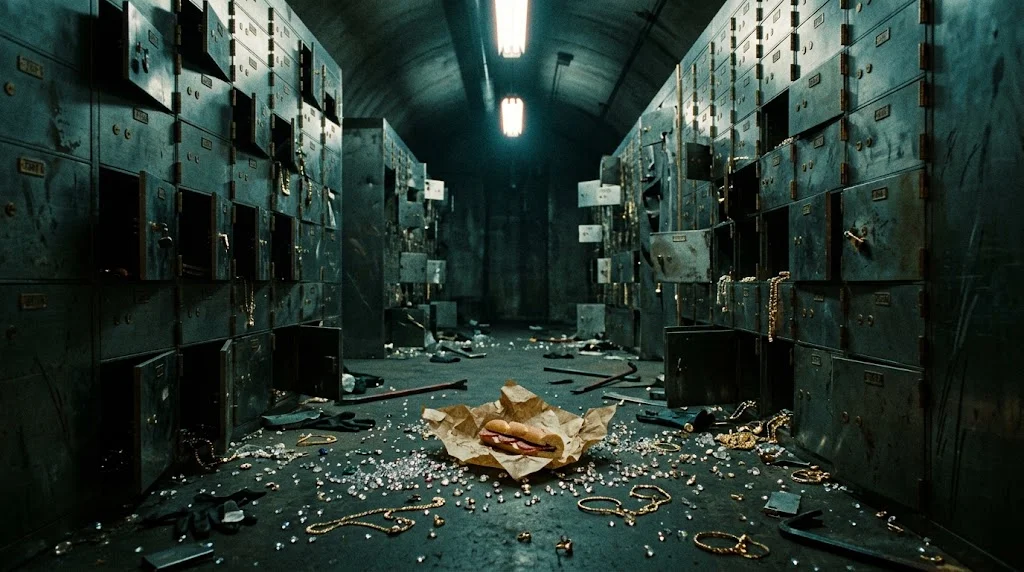
On Monday morning, staff opened the vault and found it ransacked. Empty boxes hung open on the walls, and the floor was covered in jewelry, papers and diamonds the thieves had not bothered to take.
The sandwich in the woods
After the heist, the team returned to Notarbartolo’s apartment in Antwerp. Then they needed to get rid of the evidence: the tools, packaging and rubbish from the job and from their hideout.
That task fell to Notarbartolo and "Speedy." Instead of burning everything as planned, the nervous accomplice panicked and dumped the bags in a patch of woods next to the E19 motorway between Antwerp and Brussels.
The next morning, the owner of the land found the trash and called the police. Among the debris were envelopes from the Antwerp Diamond Center, video tapes, receipts and a partly eaten salami sandwich.
The sandwich became the most famous piece of evidence in the case. Investigators matched the DNA on it to Notarbartolo. They also traced a receipt for the salami to a local shop, where security cameras had filmed one of the gang members buying it.
Five days after the heist, Notarbartolo returned to the Diamond Center, apparently acting as if nothing had happened. Detectives from Antwerp’s special diamond squad were waiting for him. He was arrested on February 21, 2003.
The trial
Notarbartolo was found guilty of organizing the heist. In 2005, the Antwerp court of appeal sentenced him to 10 years in prison. Three accomplices identified by Belgian police each received five years. The King of Keys was never identified.
Notarbartolo was released on parole in 2009, on condition that he compensate the victims. He never did. In 2013, while traveling through Paris on his way from the United States to Turin, he was arrested again under a European arrest warrant and sent back to prison to finish his sentence.
"It was an inside job"
In a famous 2009 interview with Wired magazine, Notarbartolo told a very different story.
He claimed that a diamond merchant had hired the team, that they had stolen only about €18 million (around $20 million) and that the robbery was really part of an insurance fraud. In his version, someone else knew the heist was coming and used it to claim insurance on diamonds that had already been removed.
Experts are skeptical. The vault had reportedly been refused insurance because of security weaknesses, which would have made such a scheme very hard to pull off. Most investigators do not consider his account believable.
But Notarbartolo has never named his supposed employer, and his story added one more layer of mystery to an already strange case.
Where are the diamonds?
This is the question that still has no answer. Although the thieves were caught and served their time, most of the stolen diamonds were never recovered.
Loose diamonds are almost impossible to trace once they are separated from their paperwork. They can be recut, mixed with legitimate stones and sold quietly through the trade. Somewhere out there, stones from the Antwerp vault may already have been set in rings and necklaces that people wear every day without knowing their history.
Why the case still fascinates
The Antwerp heist has inspired a nonfiction book, Flawless by Scott Andrew Selby and Greg Campbell, an Italian TV series and the 2025 Netflix documentary Stolen: Heist of the Century.
Part of the appeal is the contrast: a crew clever enough to beat ten layers of high-tech security, undone by a sandwich and a panicked friend. It is a reminder that the weakest point in any security system is often not the technology but the people.
Sources
- Wikipedia: Antwerp diamond heist
- Wired: The Untold Story of the World’s Biggest Diamond Heist (2009)
- ABC News: Stolen Antwerp Diamonds Still Missing
- BBC News: Antwerp counts cost of gem heist (2003)
- Scott Andrew Selby and Greg Campbell, Flawless: Inside the Largest Diamond Heist in History (2010)
Leave a Reply