
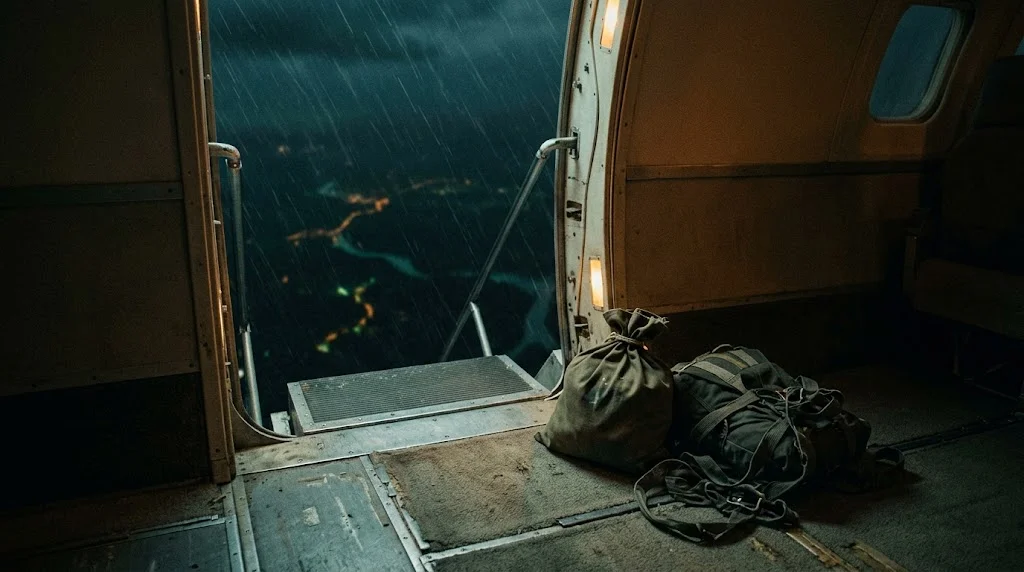
On the afternoon before Thanksgiving in 1971, a calm, polite man in a dark suit walked up to an airline counter in Portland, Oregon, paid cash for a one-way ticket and boarded a short flight to Seattle. A few hours later he had $200,000 in twenty-dollar bills strapped to his body, and he stepped out of the back of a jet into a freezing, rainy night.
He was never seen again.
The case of "D.B. Cooper" is the only unsolved hijacking in the history of American commercial aviation. The FBI chased it for 45 years, considered more than a thousand suspects and finally stopped actively investigating in 2016. The money, the parachute and the man himself have never been found, with one strange exception that only deepened the mystery.
A quiet passenger in seat 18-E
On November 24, 1971, a man who gave his name as "Dan Cooper" bought a ticket for Northwest Orient Airlines Flight 305, a 30-minute hop from Portland to Seattle. Witnesses described him as a white man in his mid-40s, with dark hair and brown eyes, wearing a business suit, a white shirt, a thin black tie and a raincoat. He carried a black attaché case.
He took a seat in the very last row of the Boeing 727 and ordered a bourbon and soda. Nothing about him stood out. That was probably the point.
Shortly after takeoff, he handed a folded note to flight attendant Florence Schaffner. She assumed it was a businessman’s phone number and slipped it into her purse without reading it. Cooper leaned over and quietly told her she had better look at it, because he had a bomb.
The note, written in neat capital letters, said he had a bomb in his briefcase and wanted her to sit next to him. When she asked to see it, he opened the case just enough to show her a tangle of wires, a large battery and several red cylinders that looked like sticks of dynamite.
The demands
Cooper’s demands were simple and very specific: $200,000 in twenty-dollar bills and four parachutes, two main and two reserve, delivered when the plane landed in Seattle.
That detail about the parachutes was clever. By asking for four, Cooper suggested he might force a crew member to jump with him. That made it far too risky for the authorities to hand him sabotaged equipment.
The airline’s president authorized the payment and ordered staff to cooperate. To give the FBI and Seattle police time to gather the cash and parachutes, the plane circled over Puget Sound for about two hours. The other passengers were told there was a minor mechanical problem. Most of them had no idea they were part of a hijacking.
Flight attendant Tina Mucklow sat with Cooper during the long wait. She later described him as calm and even polite. He looked out of the window and recognized Tacoma below, and he knew how close McChord Air Force Base was to the Seattle airport. When she asked why he had chosen her airline, he laughed and said it wasn’t because he had a grudge against the airline, just that he had a grudge.
The handoff in Seattle
Flight 305 landed at Seattle-Tacoma airport at 5:46 p.m. and parked on a dimly lit stretch of tarmac, away from the terminal. The ransom arrived in a cloth bag weighing about 19 pounds: 10,000 unmarked twenty-dollar bills. Before handing it over, the FBI had photographed the serial number of every single bill.
Mucklow carried the money down the aisle to the last row. Cooper then let all 36 passengers and two of the flight attendants leave. He kept the pilots, the flight engineer and Mucklow on board.
At one point, Mucklow jokingly asked whether she could have some of the money. Cooper handed her a stack of bills without hesitation. She gave it straight back, explaining that accepting tips was against company policy.
While the plane was refueled, Cooper gave the crew a very unusual flight plan. He wanted to fly toward Mexico City with a refueling stop in Reno, Nevada. He ordered the pilots to keep the plane at no more than 10,000 feet, at the slowest speed possible without stalling, with the landing gear down, the wing flaps set at 15 degrees and the cabin unpressurized.
Those instructions revealed something important: this was a man who understood airplanes, and the Boeing 727 in particular.
The jump
At around 7:40 p.m., the plane took off again with only five people on board. Two fighter jets from McChord followed at a distance, out of Cooper’s sight.
Cooper told Mucklow to go to the cockpit, close the curtain and stay there. The last time she saw him, he was standing in the aisle, tying what looked like the money bag around his waist.
Around 8:00 p.m., a warning light in the cockpit showed that the rear airstair had been lowered. The pilots asked over the intercom whether Cooper needed help. He said no. At about 8:13 p.m., the tail of the plane suddenly pitched upward. The crew believe that was the moment he jumped, somewhere over the forests of southwest Washington, in the dark, in the rain, wearing loafers and a business suit.
Nobody actually saw him leave. The crew flew on to Reno with the rear stairs still down, unsure whether he was still on board. When the plane landed at 11:02 p.m. and the cabin was searched, Cooper was gone. So was the money.
The secret of the Boeing 727
Cooper’s choice of plane was not random. The 727 had a rear airstair that could be lowered in flight, and its engines were positioned so that a person could jump from the back without being sucked into them. Even more importantly, the stairs could be controlled from the rear of the cabin, and the pilots could not override them from the cockpit.
Ordinary airline crews did not know this. The FBI later suspected Cooper may have learned it from military experience, since 727s were reportedly used during the Vietnam War to drop people and supplies.
After his jump, and a wave of copycat hijackings in 1972, aircraft makers added a simple mechanical device that stops a rear airstair from being opened in flight. It is still known today as the "Cooper vane."
What he left behind
Cooper had been careful. Before jumping, he made Mucklow give back every note he had written. He even asked for his empty matchbook. But he did leave a few things behind:
- A black clip-on tie from J.C. Penney, with a mother-of-pearl tie clip, left on his seat.
- Two of the four parachutes. One of them was a reserve that had been cut open, and some of its cords were missing.
- Eight cigarette butts in the armrest ashtray.
The cigarette butts were later destroyed while in storage, before modern DNA testing was possible. The tie, however, became one of the most studied pieces of evidence in the case. In 2001 the FBI extracted a partial DNA profile from it, although it could never prove that the DNA actually belonged to the hijacker.
Years later, a team of private researchers examined the tie under an electron microscope and found tiny particles of pure titanium and rare metals. In the early 1970s, pure titanium was used almost only in aerospace and specialized chemical plants. That led some investigators to believe Cooper may have worked in the aviation industry, perhaps even for Boeing.
There was one more twist. One of the reserve parachutes Cooper received was a training dummy that had been sewn shut and could never open. It was never found on the plane, which suggests he took it with him, possibly to carry money. If he did not notice it was useless, that hints he was not as expert a parachutist as he appeared.
The search
The FBI named the case NORJAK, short for Northwest Hijacking. It became one of the largest manhunts in the Bureau’s history.
Agents and soldiers searched the forests of Clark and Cowlitz counties on foot and by helicopter. A submarine was used to search the depths of Lake Merwin. An SR-71 Blackbird spy plane was even sent to photograph the flight path, without success. In the spring of 1972, hundreds of soldiers from Fort Lewis joined another long ground search.
They found nothing linked to Cooper. Not a body, not a parachute, not a single bill.
A month after the hijacking, the FBI sent the list of serial numbers to banks, casinos and businesses around the world, and newspapers offered rewards to anyone who found a ransom bill. None ever turned up in circulation.
The money on the riverbank
Then, in February 1980, more than eight years after the hijacking, an 8-year-old boy named Brian Ingram was on a family trip along the Columbia River, a few miles downstream from Vancouver, Washington. While raking the sand to make a campfire, he uncovered three rotting bundles of twenty-dollar bills, still held together by rubber bands.
The FBI confirmed the serial numbers matched Cooper’s ransom. The total was about $5,800.
The discovery should have answered questions. Instead, it created new ones. How did three bundles of cash end up together on a riverbank, so far from where the FBI believed Cooper had landed? Had they washed down a river, or had someone buried them? Why was the rest of the money never found?
Scientists have argued about it ever since. A 2020 analysis of microscopic algae on the bills suggested they entered the water in spring, at least several months after the November hijacking. If that is right, the money did not simply fall into the river the night Cooper jumped.
To this day, those bills are the only physical evidence of the hijacking ever found outside the plane.
Did he survive?
The FBI never took an official position, and even its own agents disagreed.
Some believed Cooper got away with it. The night was survivable, they argued, the 727 was a good aircraft to jump from, and parts of the area below were open and flat enough for a safe landing.
Others were convinced he died that night. Larry Carr, who led the case from 2006 to 2009, pointed out that no experienced skydiver would have jumped at night, into rain and freezing wind, wearing loafers and a trench coat, with a parachute that could not be steered. And if Cooper had survived, why did he never spend the money?
The FBI’s own history page notes that the parachute he used could not be steered, his clothing was unsuitable and he jumped into a wooded area at night. Perhaps, the Bureau suggests, he simply did not survive the jump.
So who was D.B. Cooper?
First, a small mystery inside the big one: his name was never "D.B." The hijacker called himself Dan Cooper. In the rush of the first night, a reporter wrote the name down as "D.B. Cooper", other outlets repeated it, and the mistake stuck forever. Police did question a local man named D.B. Cooper, but he was quickly cleared.
Investigators believe "Dan Cooper" may have been borrowed from a French-language comic book about a heroic test pilot, which circulated in Europe and Canada but was never published in English. That led to speculation that the hijacker had spent time abroad, perhaps in the military.
Over the decades, the FBI looked at more than a thousand serious suspects. Some of the best known, all now deceased, include:
- Richard McCoy Jr., a Vietnam veteran and skydiver who hijacked a United Airlines 727 in almost exactly the same way just five months later and was caught with the money. The FBI ruled him out as Cooper because he did not match the witnesses’ descriptions: he was much younger, had light blue eyes and did not smoke or drink.
- Kenneth Christiansen, a former paratrooper who worked for Northwest Orient Airlines. His brother became convinced he was Cooper, but the FBI said there was no direct evidence and that he did not match the physical descriptions.
- Robert Rackstraw, a former Army pilot investigated in the late 1970s and featured in a 2016 documentary. The FBI had eliminated him decades earlier, and he denied being Cooper until his death in 2019.
Several other people have been named by relatives or researchers over the years, and some even confessed. None of these claims has ever been proven, and the FBI has never named the hijacker.
In July 2016, the FBI announced it was moving its resources to other priorities. Its case file, 66 volumes long, is now available to the public, and the Bureau still accepts genuine physical evidence related to the parachutes or the money.
Why the case still matters
Beyond the legend, D.B. Cooper changed air travel forever. His hijacking and the copycats that followed in 1972 pushed authorities to introduce metal detectors and mandatory baggage checks at airports. Every time you walk through airport security, you are living with part of Cooper’s legacy.
And somewhere out there, there may still be about $194,000 in 1971 twenty-dollar bills, buried in the mud, rotting in a forest or sitting in an attic, waiting for someone to find them.
Leave a Reply