
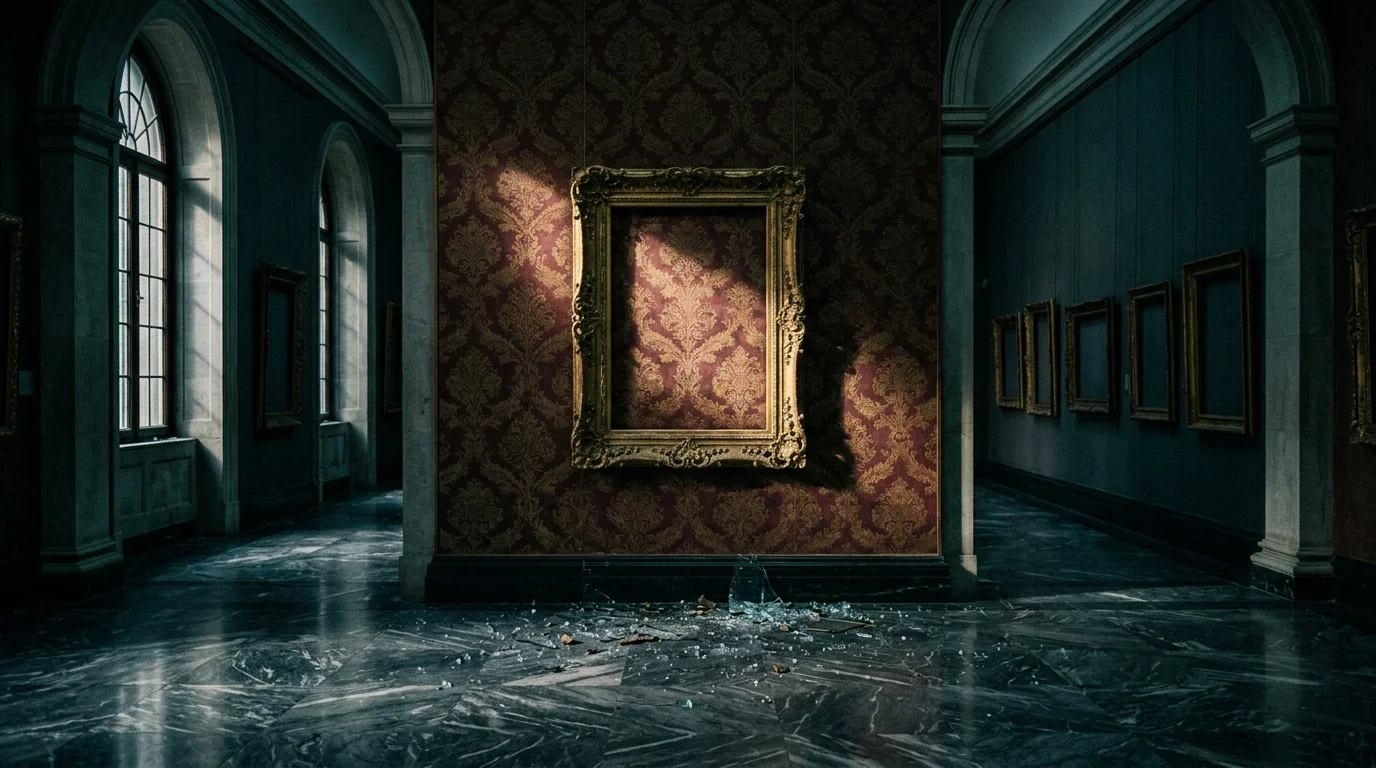
In a quiet museum in Boston, there are empty picture frames hanging on the walls. They are not an art installation. They have been waiting more than 35 years for the paintings that were cut out of them to come home.
In the early hours of March 18, 1990, two men dressed as police officers talked their way into the Isabella Stewart Gardner Museum. When they left 81 minutes later, they had taken 13 works of art, including masterpieces by Vermeer, Rembrandt, Manet and Degas. The FBI values the haul at more than $500 million, which makes it the largest property crime in the world.
No one has ever been charged. Not a single piece has been recovered. And the museum is still offering a $10 million reward.
A museum frozen in time
To understand why this theft hurts so much, you need to know the woman behind the museum.
Isabella Stewart Gardner was a wealthy Boston collector who built a Venetian-style palace to display her treasures. It opened to the public in 1903, and she kept arranging the collection herself until her death in 1924. Her will was strict: the arrangement of the art must never change, nothing could be sold and nothing new could be added.
That rule kept the museum exactly as she left it. But by the 1980s, money was tight. The building needed repairs, there was no climate control and, incredibly, the collection was not insured against theft.
There had even been a warning. In 1982, the FBI uncovered a plot by Boston criminals to rob the museum. The museum responded by installing motion detectors and four security cameras around the outside of the building. But there were no cameras inside, and the only way the night guards could call the police was a single panic button at the security desk.
St. Patrick’s night
March 17, 1990, was St. Patrick’s Day, and Boston was celebrating. Around 12:30 a.m., people leaving a party nearby noticed two men in police uniforms sitting in a hatchback near the museum’s side entrance. Nobody thought twice about it.
Inside, two young guards were on duty. For one of them, it was his very first night shift.
At 1:24 a.m., the two "officers" rang the buzzer at the side door. Over the intercom, they said they were responding to a disturbance and needed to come in. On the security monitor, the guard at the desk could see what looked like real police uniforms. It was the night of St. Patrick’s Day, and he assumed some partygoer had climbed the fence. Against museum rules, he buzzed them in.
That was the moment the museum was lost.
"This is a robbery"
Once inside, one of the men told the guard he looked familiar and that there might be a warrant for his arrest. He asked him to step out from behind the desk and show his ID. The guard did, and in doing so he walked away from the only panic button in the building.
The fake officers pushed him against a wall and handcuffed him. When the second guard arrived, they handcuffed him too. Only then did they reveal the truth: this was a robbery.
The thieves wrapped duct tape around the guards’ heads and led them down to the basement, where they handcuffed them to a pipe and a workbench. They went through their wallets and warned them they knew where they lived. If they kept quiet, the men said, they would get a reward in about a year.
The whole thing took less than 15 minutes. Then, oddly, the thieves seem to have waited about 13 minutes before going upstairs, perhaps to make sure no alarm had reached the police.
81 minutes inside
The museum’s motion detectors recorded every step the thieves took. Their first stop was the Dutch Room on the second floor, home to some of the most valuable works in the collection.
When they got too close to a painting, a small alarm went off. They smashed it.
Then they pulled Rembrandt’s The Storm on the Sea of Galilee and A Lady and Gentleman in Black off the wall, threw them on the floor and shattered the glass. Using a blade, they cut the canvases out of their frames.
They also took:
- The Concert by Johannes Vermeer. Vermeer left behind only around 34 known paintings, and this one is thought to be the most valuable stolen painting in the world. On its own it may account for half the value of the entire theft.
- A tiny Rembrandt self-portrait etching, about the size of a postage stamp.
- Landscape with an Obelisk, long believed to be a Rembrandt but credited to his student Govert Flinck a few years before the heist.
- An ancient Chinese bronze beaker, more than 3,000 years old.
- Five small sketches by Edgar Degas.
- A bronze eagle from the top of a Napoleonic flagpole. The thieves tried to unscrew the frame holding the flag itself, then gave up and took only the eagle.
- Chez Tortoni by Édouard Manet, taken from a room on the first floor.
The Storm on the Sea of Galilee is especially painful to lose. It is Rembrandt’s only known seascape.
Before leaving, the thieves went back to check on the guards and even asked whether they were comfortable. They took the videotapes from the security cameras and the printouts from the motion detectors. They missed one thing: the motion data was also saved on a hard drive, which is how we know their movements today.
The side door opened for the last time at 2:45 a.m. The robbery had lasted 81 minutes.
The guards stayed tied up in the basement until the next shift arrived in the morning and realized nobody was answering the door.
The strangest choices
The more investigators studied the crime, the less sense it made.
The thieves walked past works by Raphael, Botticelli and Michelangelo. They never went up to the third floor, where Titian’s The Rape of Europa, one of the most valuable paintings in Boston, was hanging. Instead, they took a flag ornament and a Chinese beaker worth a few thousand dollars.
They also treated priceless art roughly, slicing canvases and probably rolling them up. That convinced many experts that these were not refined art thieves working for a collector. They were criminals who grabbed what looked valuable.
There is one more puzzle. The motion detectors never recorded anyone entering the room where the Manet was hanging that night. The only footsteps logged there belonged to one of the guards, during his earlier patrol. A security consultant later checked the system and found it working correctly. That detail has fuelled theories for decades, although nothing was ever proven.
The empty frames
After the theft, the museum faced a strange problem. Isabella Gardner’s will said nothing could be moved. So the staff did something unforgettable: they left the empty frames hanging exactly where the paintings used to be.
Visitors today can stand in front of them. They work as a memorial, and as a promise that the museum is still waiting.
Who did it?
With no strong physical evidence, the FBI had to rely on informants, interrogations and undercover operations. Over the years, the investigation pointed in several directions.
The Boston underworld. Investigators looked hard at Boston’s criminal gangs, which were in the middle of an internal war at the time. One theory says a mobster named Bobby Donati organized the theft as a bargaining chip, hoping to trade the art for the release of his jailed boss. Donati was murdered in 1991, about a year after the robbery.
Whitey Bulger. The notorious crime boss was an obvious name. He denied any involvement and reportedly sent his own men to find out who had done a job on his turf without paying him.
A mysterious negotiator. In 1994, the museum’s director received an anonymous letter from someone offering to arrange the return of the art for $2.6 million and immunity. The writer knew details only the museum and FBI were aware of. The museum placed a coded reply in The Boston Globe, as instructed. A second letter arrived, saying the writer had become nervous about the investigation. Then nothing, ever again.
In 2013, the FBI made a major announcement. It said it was confident it knew who the thieves were: members of a criminal organization based in the mid-Atlantic and New England. It also believed the paintings had been moved to Connecticut and the Philadelphia area, where someone tried to sell them in the early 2000s. After that, the trail went cold.
In 2015, the FBI said both thieves were dead. It has never officially named them.
The $10 million reward
Right after the theft, the museum offered a $1 million reward. It rose to $5 million in 1997 and was doubled to $10 million in 2017, the largest reward ever offered by a private institution. The museum has extended it ever since.
Here is how it works, according to the museum and the FBI:
- The full $10 million is for information leading directly to the recovery of all 13 works in good condition.
- Partial rewards are available for information that leads to the return of individual pieces.
- A separate $100,000 reward is offered for the bronze eagle alone.
There is another twist that makes this case unusual. The statute of limitations on the theft expired in 1995, and federal prosecutors have said that anyone who willingly returns the art will not be prosecuted for it. In theory, even someone who knows exactly where the paintings are could come forward and collect the reward.
So far, nobody has.
Where is the art now?
Nobody knows. The FBI believes the 13 works were split up after the robbery and could be anywhere in the world. Some pieces are thought to have moved along the East Coast and further south.
Conservators worry about something else. Paintings cut from their frames, rolled up and stored in the wrong conditions for more than three decades may be badly damaged. Some may not have survived at all.
But as long as there is a chance, the frames stay on the wall.
If you know something
The museum and the FBI are still asking for tips. Information can be sent to the museum at reward@gardnermuseum.org, or to the FBI at 1-800-CALL-FBI or tips.fbi.gov.
Leave a Reply